




Salkantay Trek Guide: Itinerary, Packing List & Best Time to Hike to Machu Picchu
The Salkantay trek to Machu Picchu is one of the most rewarding ways to experience the Trek, offering an unforgettable journey through the heart of the Andes on the route to Machu Picchu. Unlike the Inca Trail, this route is less crowded, making it ideal for hikers seeking a more immersive and adventurous trekking experience, surrounded by nature and breathtaking mountain scenery.
This epic route covers approximately 74 kilometers (46 miles) and can be completed as a 4-day or 5-day adventure, depending on the pace and itinerary you choose. Along the Trek, you’ll witness dramatic changes in scenery, moving from towering snow-capped peaks to lush cloud forests, creating a unique contrast that makes this trek one of the most diverse in Peru.
The highlight is crossing the impressive Salkantay Mountain (6,271 meters / 20,574 feet), one of the highest peaks in the region, before descending into warmer landscapes on your way to Machu Picchu. This transition in altitude and climate is part of what makes the trek so special and memorable for travelers.
To fully enjoy the experience, every hiker should come prepared with the right gear, including sturdy hiking boots, a comfortable backpack, a warm sleeping bag, and a basic first aid kit for safety, ensuring a smoother and more comfortable journey along the trail.
Since the trek reaches altitudes of up to 4,600 meters (15,091 feet), proper acclimatization is essential, and carrying basic first aid supplies becomes especially important to ensure safety and reduce the risk of altitude-related issues during the hike.
Along the trek, each day offers unique challenges and incredible views, culminating in the final day when you’ll reach the breathtaking view of Machu Picchu, making all the effort along the journey truly worthwhile.
Whether you choose a multi-day adventure or a shorter day hike section, trekking the Salkantay route means experiencing one of Peru’s most stunning landscapes, filled with natural beauty and unforgettable moments. After completing the journey, most travelers return to Cusco, reflecting on an incredible adventure through one of the most scenic routes in South America.
A Look at the Day-by-Day Itinerary
Embarking on the Salkantay Trek in Peru is a true Salkantay adventure through the stunning Vilcabamba mountain range, widely recognized as the best alternative to the Inca Trail.
This challenging trek offers a unique journey along the Salkantay Trail, combining breathtaking landscapes, cultural encounters, and the ultimate reward: reaching Machu Picchu via the Salkantay route.
The Salkantay Trek itinerary typically spans 4 to 5 days of trekking, and while the Salkantay Trek does not require permits like the Classic Inca Trail, proper preparation for the Salkantay is essential.
Because this trek reaches high altitude, it is important to pack light, pack for hiking, and bring everything required for the Salkantay Trek, including items from a complete Salkantay Trek packing list to ensure safety and peace of mind.
Day 1: Mollepata to Soraypampa (14 km / 8.7 miles)
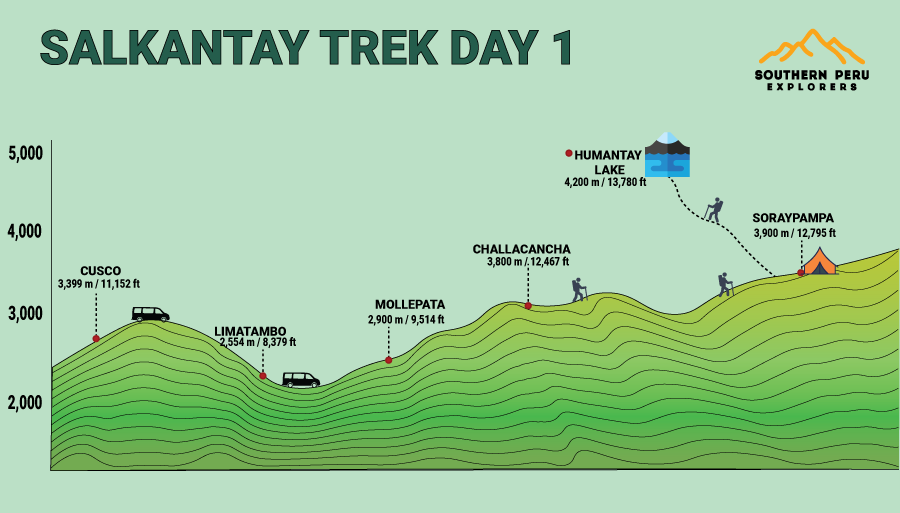
Duration: 5–6 hours
Highlights:
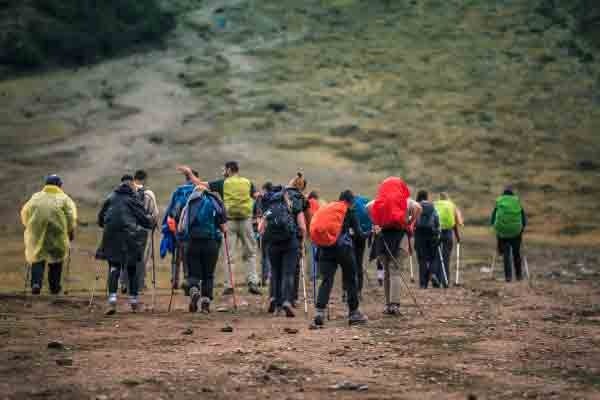
Starting in Mollepata, you begin your journey along the Salkantay route by passing through traditional Andean villages, farmland, and scenic valleys. This first day offers a gentle and well-paced introduction to the trek, allowing your body to gradually adapt to the altitude while enjoying open landscapes and views of the surrounding mountains.
As you hike deeper into the Andes, the terrain becomes more expansive and the scenery more impressive, with valleys giving way to higher-altitude environments. You will arrive at Soraypampa, a stunning campsite surrounded by towering peaks, where you’ll enjoy your first close views of the majestic Salkantay Mountain and nearby glaciers—an inspiring start to the adventure.
Day 2: Soraypampa to Chaullay (22 km / 13.6 miles)
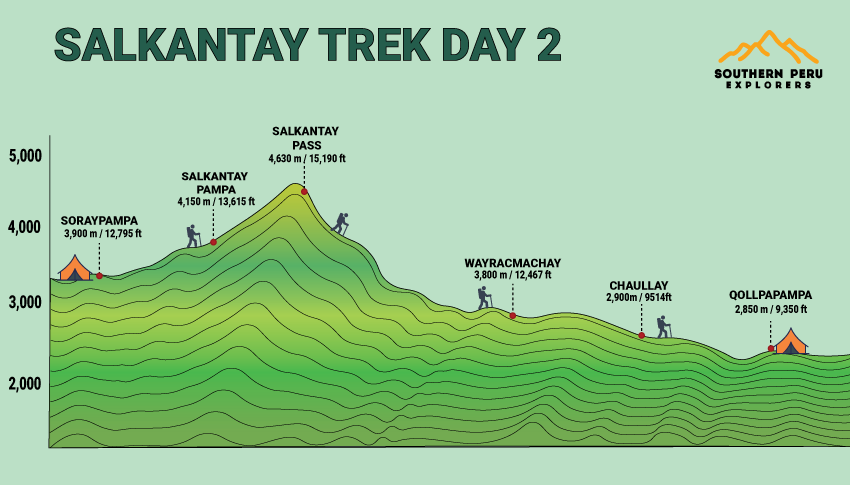
Duration: 7–8 hours
Highlights:
This is the most demanding and rewarding day of the trek, as you cross the Salkantay Pass, the highest point at 4,600 meters (15,091 feet). The steady ascent is physically challenging due to the altitude and steep terrain, but it offers spectacular panoramic views of snow-capped peaks, glaciers, and dramatic mountain landscapes.
After reaching the summit, you begin a long descent into the cloud forest, where the scenery gradually transforms. The cold, high-altitude environment gives way to warmer temperatures, lush vegetation, and flowing streams, marking one of the most striking transitions of the entire Salkantay route.
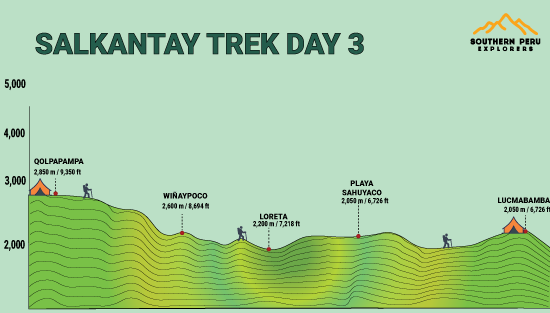
Day 3: Chaullay to La Playa (15 km / 9.3 miles)
Duration: 5–6 hours
Highlights:
This day highlights the rich natural diversity of the Salkantay route as you hike through lush vegetation, tropical landscapes, and river valleys. The warmer climate makes the walk more comfortable, with a noticeable change from the high Andes to the cloud forest. Along the way, you’ll pass plantations of coffee, bananas, avocados, and other local crops, often with opportunities to learn about traditional farming practices.
The trail also crosses small rural communities and follows parts of the valley, offering a closer look at local life and culture. With gentler terrain compared to previous days, this stage allows you to enjoy the scenery at a relaxed pace while continuing deeper into the Santa Teresa region.
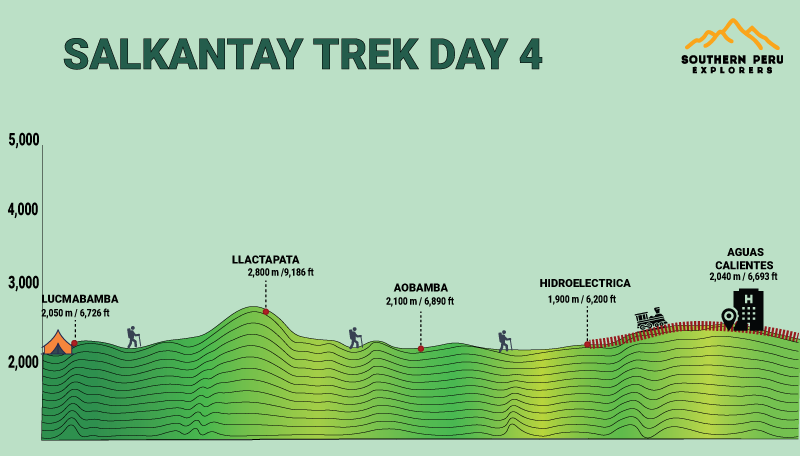
Day 4: La Playa to Aguas Calientes (19 km / 11.8 miles)
Duration: 6–7 hours
Highlights:
Continuing your journey along the Salkantay route, you will hike through lush valleys and gradually descend into a warmer, subtropical environment. The trail offers a mix of shaded paths, river crossings, and scenic viewpoints, with occasional glimpses of the surrounding mountains and dense vegetation. As you approach Hidroeléctrica, the landscape becomes more humid and vibrant, marking your transition into the edge of the Amazon basin.
From here, you can choose to continue walking along a relatively flat and easy trail that follows the railway line toward Aguas Calientes, passing small rest stops and enjoying views of the Urubamba River. Alternatively, you may take a short train ride for added comfort. This section is significantly less physically demanding compared to previous days, allowing you to relax, take photos, and fully appreciate the surroundings.
Along the way, you may spot local flora and fauna, as well as hear the distant sounds of the river and train moving through the valley. Upon arrival in Aguas Calientes, you will check into your accommodation, enjoy a well-deserved rest, and attend a short briefing to prepare for your visit to Machu Picchu the following day—highlighting entry times, routes, and important recommendations to make the most of your experience.
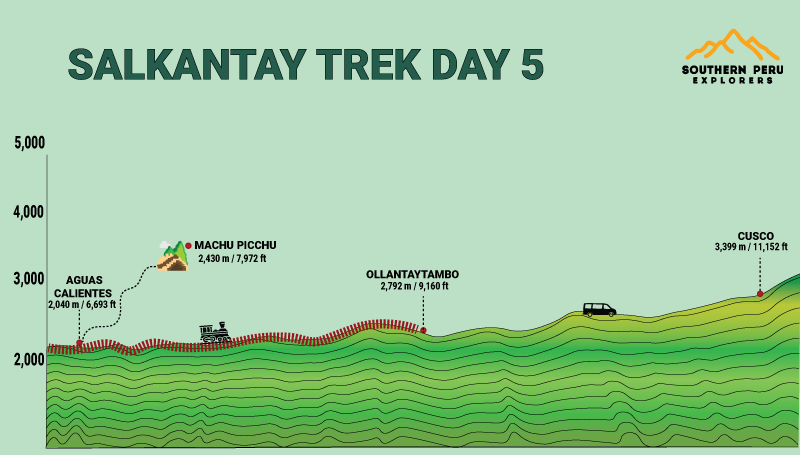
Day 5: Aguas Calientes to Machu Picchu
Duration: 2–3 hours
Highlights:
On the final day, you will either hike early in the morning or take the bus to Machu Picchu for a guided visit. Arriving at sunrise is a truly memorable experience, as the citadel gradually reveals itself through the morning mist, creating a unique and almost magical atmosphere.
This is the ultimate highlight of completing the Salkantay Trek, where you finally explore Machu Picchu and discover its history, architecture, and incredible surroundings. Walking through one of the most iconic archaeological sites in the world makes all the effort of the previous days truly worthwhile, bringing your journey to a rewarding and unforgettable conclusion.
Key Places You will Visit during the Salkantay Trek
Choosing the Salkantay Trek over the Inca Trail means discovering one of the most diverse and scenic routes in Peru. This alternative route is widely recognized for its dramatic contrasts, taking you from high-altitude mountain passes to lush cloud forests and tropical valleys, all while offering a quieter and more immersive experience.
Each day of the trek reveals something new—from the towering presence of Salkantay Mountain and glacial landscapes to remote valleys, coffee-growing areas, and finally the path leading to Machu Picchu. These changing environments, combined with cultural encounters along the way, make the Salkantay Trek an unforgettable journey from start to finish.
Humantay Lake
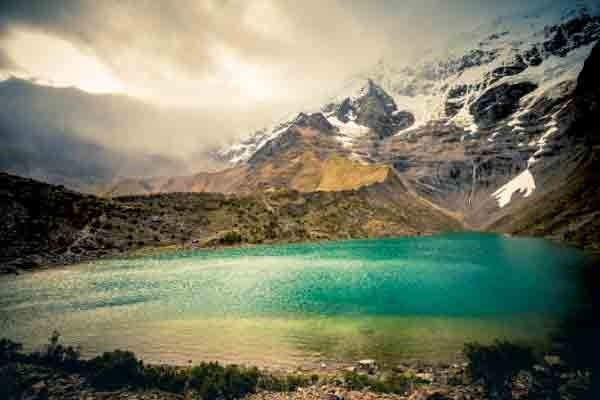
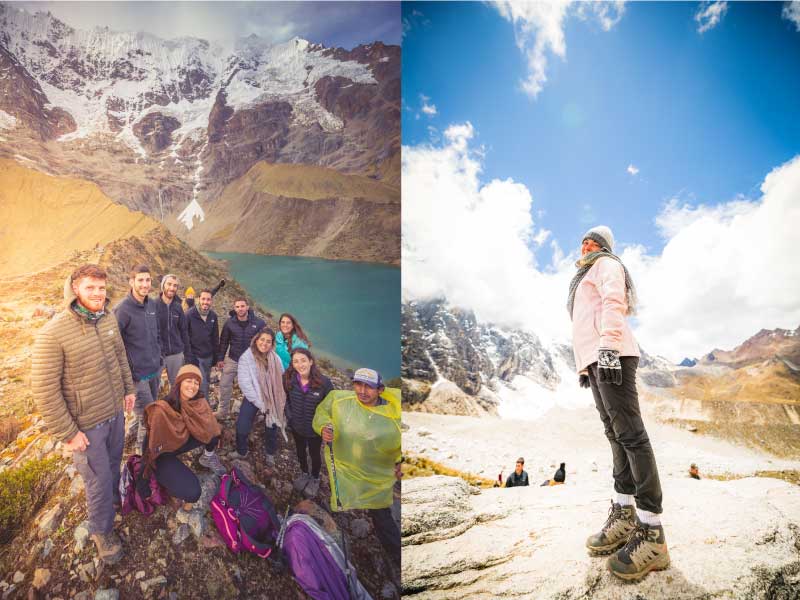
This hidden lagoon filled with glacial melt creates crystal-clear waters with bright hues of blue. Lying 4,200 meters above sea level high in the Andean mountains, this cool blue lagoon is in stark contrast to the bright white snow-capped mountains that are found there.
It is an outstanding natural phenomenon with which you start your journey on the Salkantay Trek.
Humantay is a sacred mountain for indigenous people, particularly the Quechua and Aymara cultures. They revere it as a powerful Apus, a term that refers to the mountain spirits. In traditional Andean cosmology,
mountains are considered to hold spiritual power, and many ceremonies and offerings to them still take place in the region. The lake itself wasn’t widely known to tourists until recent years, but it has been a part of local Andean culture for centuries.
Salkantay Mountain
It is one of the highest peaks in the region (6,271 meters above sea level), its snow-covered slopes offer stunning views throughout the trek. Mount Salkantay is an iconic mountain; it is the highest mountain in the Willkapampa range and the 13th highest in Peru.
Historically, Incan held its importance at a higher level, attributing it as a deity, and as such, it obtained the title of Apu. They believed that God living within Salkantay controlled the weather.
Salkantay is considered a sacred Apus by the local Quechua people, believed to possess great spiritual power. The mountain’s name comes from the Quechua words Salqa (wild) and Antay (holy), reflecting the reverence the Andean communities have for the mountain.
Salkantay Pass
The highest point of the trek (4,600 meters) provides panoramic views of glaciers and peaks around.The pass is characterized by its harsh terrain, with rocky slopes, sparse vegetation, and extreme weather conditions.
The area is often covered in snow, even in the dry season.
As with the rest of the Salkantay region, the pass is considered a sacred site by the Andean peoples. In traditional Inca times, crossing the pass was believed to be a journey into the god’s realm, a passage between the physical world and the spiritual.
Chaullay
Chaullay is a small village located in the cloud forest region of the Salkantay Trek. At an elevation of approximately 2,900 meters (9,514 feet), it is situated on the riverbanks of the Santa Teresa River.
The area is abundant with tropical vegetation and wildlife, such as orchids, hummingbirds, and other species typical of the high jungle.Like many small Andean villages, Chaullay’s culture is deeply rooted in traditional agriculture.
The people of Chaullay have a strong connection to the land, with farming being central to their way of life. Chaullay is a relatively remote village that serves as an important stopping point for trekkers along the Salkantay route.
Its population is small, with most residents relying on agriculture, including coffee cultivation, as well as the tourism industry to support their livelihoods.
Salkantay Trek vs. Other Treks
Too many trek options to get to Machu Picchu? Let’s do a little recap of all the possibilities for you to choose better.
| Feature | Inca Trail | Salkantay Trek | Lares Trek | Inca Jungle Trek |
|---|---|---|---|---|
| Popularity | The most famous trek to Machu Picchu. Requires permits that often sell out 4–6 months in advance. | Less crowded alternative with no strict permit limits, offering more flexibility. | Less popular and more remote, ideal for travelers seeking authenticity. | Growing in popularity, especially among younger and adventure travelers. |
| Experience Type | Historical and archaeological route, following original Inca paths with ruins along the way. | Adventure and nature-focused trek with dramatic landscapes and high mountain scenery. | Cultural experience focused on Andean communities, traditions, and local lifestyle. | Adventure-packed route combining trekking with activities like biking and ziplining. |
| Landscape | Mix of cloud forests, mountains, and Inca archaeological sites. | Extremely diverse: snow-capped peaks, glaciers, high passes, cloud forests, and tropical valleys. | High Andean valleys, lakes, and traditional villages with less dramatic altitude changes. | Tropical jungles, waterfalls, rivers, and lush vegetation with warm climate. |
| Difficulty | Moderate: manageable distance but includes steep stone steps and high passes. | Challenging: higher altitude (up to 4,600 m) and longer distances require good fitness. | Moderate to easy: lower altitudes and less physically demanding overall. | Moderate: lower altitude but includes physical activities like cycling and hiking. |
| Altitude | Reaches approx. 4,200 m (13,780 ft). | Highest point at 4,600 m (15,091 ft), making it the most demanding in altitude. | Slightly lower altitude compared to Salkantay, making acclimatization easier. | Lower altitude overall, reducing risk of altitude sickness. |
| Duration | Typically 4 days / 3 nights. | Usually 4 or 5 days depending on itinerary. | 3 to 5 days depending on route and connection to Machu Picchu. | Typically 4 days / 3 nights. |
| Crowds | Very crowded during peak season due to its popularity and limited permits. | Less crowded, offering a more peaceful and immersive experience. | One of the quietest treks, ideal for solitude and cultural immersion. | Less crowded than Inca Trail but more social and group-oriented. |
| Permits | Mandatory permits required; must be booked in advance. | No special permits required for the trek itself. | No permits required. | No permits required. |
| Accommodation | Organized campsites with designated areas. | Campsites or a mix of camping and basic lodges depending on the tour. | Mostly homestays or rustic accommodations in local villages. | Lodges, hostels, or basic hotels (not traditional camping). |
| Highlights | Inca ruins, Sun Gate (Inti Punku), direct entrance to Machu Picchu. | Salkantay Pass, Humantay Lake (optional), dramatic mountain scenery. | Interaction with local communities, traditional weaving, authentic culture. | Adventure sports, jungle scenery, and diverse activities. |
| Best For | History lovers and those wanting the classic Machu Picchu experience. | Adventure seekers and hikers looking for stunning landscapes and a physical challenge. | Cultural travelers interested in authentic Andean life and traditions. | Travelers looking for a mix of adventure, fun, and varied outdoor activities. |
Important Tips and Things to Keep in Mind
The Salkantay Trek is considered a challenging but highly rewarding adventure, so proper preparation is essential to fully enjoy the experience. Before starting the trek, it is strongly recommended to spend at least 2–3 days in Cusco or a similar altitude to acclimatize properly and reduce the risk of altitude sickness, which can affect your performance and overall comfort during the hike.
Packing smart and light is key for a successful trek. Bring layered clothing to adapt to the constant changes in temperature, as mornings and nights can be very cold while daytime conditions may be warmer. Comfortable and well-broken-in hiking boots are essential to avoid blisters, and you should also carry important items such as a reusable water bottle, sunscreen, rain protection, and a basic first aid kit. Staying hydrated, protected from the sun, and properly equipped will make a significant difference throughout the journey.
The best months to hike the Salkantay are during the dry season (April to October), when weather conditions are generally more stable, trails are safer, and mountain views are clearer. However, temperatures can drop significantly at higher altitudes, especially at night, so being prepared for cold conditions is important even during the dry season.
Since the Salkantay Trek takes several days to complete and involves long distances and high elevations, it is important to manage your energy levels and maintain a steady pace. Take regular breaks, eat well, and listen to your body at all times to avoid exhaustion or altitude-related discomfort.
By planning ahead, staying well-prepared, and taking things step by step, you will be able to fully enjoy the beauty of the Salkantay Trek and make the most of this unforgettable journey to Machu Picchu.